World
Ore distribution and Y levels
Since the Caves & Cliffs update ores are no longer spread evenly — each one has a band where it is most common. These are the numbers for Java Edition 1.21.4.
World generation places most ores on a triangular distribution: rare at the edges of their range and most common at a peak level. Mining at that peak is the single biggest thing you can do to find more of a given ore per hour. The bars below show each ore’s full range against the world height of −64 to 320, with the peak marked.
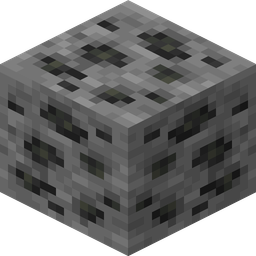
The most abundant ore in the game and the first one every player mines. It generates in very large veins, up to seventeen blocks, and is exposed constantly on mountain and cliff faces, so surface prospecting usually beats digging for it. Coal fuels furnaces at eight items each and crafts torches, which matters far more early than the ore itself. Once you have a full set of iron, most players stop mining coal deliberately and burn charcoal or lava instead.
A second, upper band generates roughly from Y=136 to Y=320 and is what makes coal so easy to find on mountainsides and cliff faces. Coal does not generate in the lowest few layers of the world.
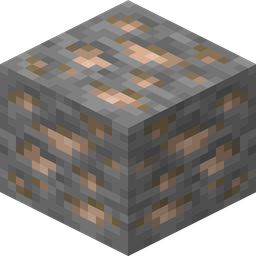
Iron is the backbone of the mid game and the ore with the widest generation range of any: it appears in mountain peaks above Y=200 and in deep caves alike. Since 1.18 the mountain band has made snowy peaks and jagged peaks a genuinely fast way to gather iron without going underground at all. Ore drops raw iron rather than the block, so a furnace or blast furnace is still required. Iron golem farms eventually replace mining entirely.
Iron generates in three overlapping bands: this middle one peaking at Y=16, a large mountain band from about Y=80 to Y=384 peaking near Y=232, and a small, thinly scattered band from bedrock up to about Y=72.
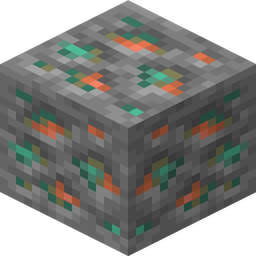
Copper generates in very large veins and drops two to five raw copper per block, so a single vein can yield most of a stack. It oxidises through four visible stages when placed, which can be locked at any stage with honeycomb, and it feeds lightning rods, spyglasses, brushes, and the whole copper block family used in trial chambers. Dripstone caves around Y=48 are the single best place to mine it.
A second, much larger blob variant generates specifically in dripstone caves, which are by far the fastest place to gather copper in bulk.
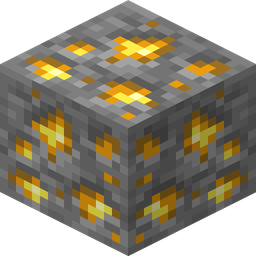
Overworld gold is scarce and needs an iron pickaxe, but badlands biomes break the rule completely: gold generates near the surface there in enormous quantity, exposed in the mesa cliffs and abandoned mineshafts. Gold is soft and near-useless for tools, yet essential for powered rails, clocks, golden apples, and the gold armour that makes piglins tolerate you. Most players get their gold from Nether bartering rather than the Overworld.
Badlands biomes have a separate, much richer distribution that generates gold in the open from roughly Y=32 up to Y=256, often visible in the terracotta cliffs without mining at all.
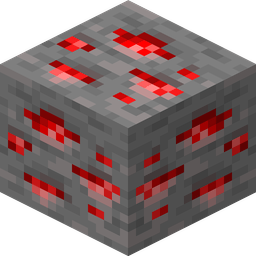
Redstone sits in the deepest layers alongside diamond, so a single strip mine at Y=-59 harvests both at once. Each block drops four to five dust before Fortune, which is generous enough that redstone rarely becomes a bottleneck once you reach deepslate. The ore lights up and emits particles when a player or mob touches it, which makes it easy to spot in an unlit cave, and it stays lit for a few seconds afterwards.
A second, uniform band generates from bedrock up to about Y=15, which is why redstone turns up on the way down as well as at the bottom. Density increases steadily below Y=-32.
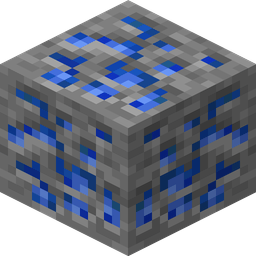
Lapis is unusual in peaking right around sea level rather than at the bottom of the world, so the fastest way to gather it is a branch mine at Y=0 rather than a trip to bedrock. Every enchantment on an enchanting table costs one to three lapis, and it is also the blue dye for banners and concrete, so a player who enchants often will always want more of it than they have.
A second "buried" distribution generates from about Y=-64 to Y=64 but only in positions with no air exposure, so those veins are never visible from a cave wall and are only found by digging.
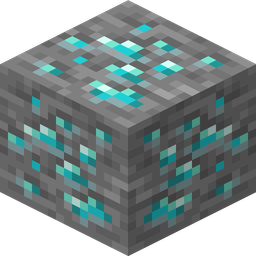
Diamond is densest at the absolute bottom of the world, but bedrock fills Y=-64 to about Y=-59 and lava lakes pool at Y=-54, so Y=-59 is the practical mining level and Y=-53 is the safer compromise. Fortune III averages roughly two and a bit diamonds per ore block, more than doubling a mining trip. Diamonds gate the enchanting table, the Nether's ancient debris, and every netherite upgrade after it.
Diamond density increases continuously the deeper you go, peaking at the very bottom of the world. A second, rarer "large" distribution generates buried with no air exposure, which is why open-cave prospecting finds less diamond than tunnelling.
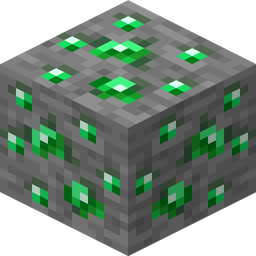
Emerald is the rarest ore in the Overworld and almost always generates as a single block rather than a vein, which makes deliberate mining for it slow. It is restricted to mountain biomes and peaks high up around Y=236, so the fastest approach is tunnelling horizontally through a jagged peak rather than digging down. In practice almost no one mines emeralds seriously: villager trading produces them far faster.
Generates only in mountain biomes: windswept hills, windswept gravelly hills, windswept forest, meadow, grove, snowy slopes, jagged peaks, frozen peaks, stony peaks and cherry grove. It does not generate anywhere else at any depth.
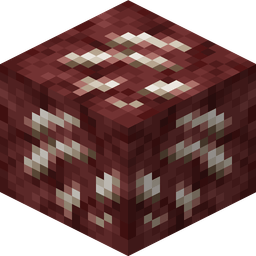
Quartz is everywhere in the Nether, easy to spot as white speckles against red netherrack, and needs only a wooden pickaxe. It is the crafting ingredient for observers, comparators and daylight sensors, and quartz blocks are one of the cleanest building materials in the game. Basalt deltas are the best biome to farm it in, though they are also the most dangerous to move through.
Uniform throughout the Nether at these levels, with no peak. Basalt deltas generate substantially more quartz than other Nether biomes.
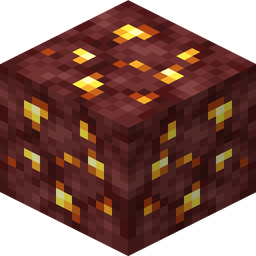
Nether gold ore drops two to six gold nuggets rather than raw gold, so nine blocks make roughly four ingots, and it only needs a wooden pickaxe. It is far more common than Overworld gold, which makes the Nether the practical place to gather gold for bartering with piglins. Mining it within sight of a piglin angers every piglin nearby, so clear the area or wear gold armour and mine out of view.
Uniform throughout the Nether at these levels. Does not generate in basalt deltas.
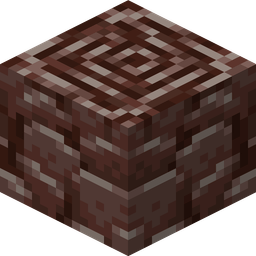
The rarest ore in the game, generating one to three blocks per chunk and never exposed to open air, so cave prospecting is useless. Standard technique is a strip tunnel at Y=15 cleared with beds or TNT. It is fireproof and floats in lava, so debris blasted loose survives. Smelt it into netherite scrap; four scrap plus four gold ingots make one netherite ingot, which upgrades a single diamond item.
A second, much rarer distribution scatters single blocks from about Y=8 to Y=119. Ancient debris never generates exposed to air, so it is invisible from caves and must be found by tunnelling, bed mining or TNT.

Amethyst clusters grow through four stages on budding amethyst inside geodes, and a fully grown cluster mined with a pickaxe drops four shards, multiplied by Fortune. Because budding amethyst regrows clusters indefinitely and cannot be moved, a geode is a permanent renewable farm rather than a deposit to strip. Shards make spyglasses, tinted glass, and the calibrated sculk sensor, and amethyst blocks chime when walked on.
Amethyst is not an ore vein. It grows on budding amethyst inside geodes, which generate uniformly anywhere in this range with no density peak, occasionally breaking the ocean floor or a cliff face.