Overview
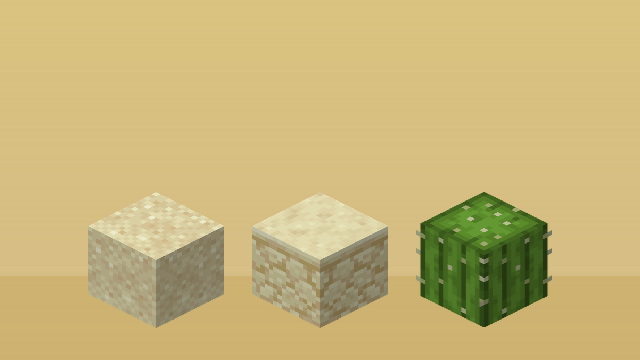
Desert is a flat sea of sand and sandstone where it never rains, nothing grows on its own except cactus, dead bush and sugar cane at the water's edge, and no passive animals spawn at all — no sheep, no cows, no pigs, only rabbits. On the surface, husks spawn in place of ordinary zombies, and because husks do not burn in daylight they are still walking about at noon, inflicting Hunger with every hit. What the desert lacks in food it makes up for in structures. Desert villages generate here and are the only place camels spawn, desert pyramids hide a four-chest treasure chamber over nine blocks of TNT, and desert wells and pyramid floors carry suspicious sand for archaeology, which is the only source of several pottery sherds. Fossils generate underground in desert biomes, giving bone blocks without a farm. Sand is the practical haul: it smelts into glass, forms concrete powder with gravel and dye, and it is the only ingredient in TNT besides gunpowder. Deserts border badlands, savanna, plains and ocean, and the sand simply stops at the border with no transition slope.
Sand for glass, concrete and TNT, sandstone for building, desert temples and villages for loot, camels for 2-player travel, suspicious sand for pottery sherds, and cactus for green dye and a mob grinder.
Desert sits in the hot band of Minecraft's biome table, generating in the Overworld at a base temperature of 2.
No precipitation falls in Desert. It never rains or snows here, so cauldrons stay empty and lightning does not strike.
6 generated structures can appear here, among them Village, Desert Pyramid, Pillager Outpost and 3 more.
3 mobs name Desert specifically among their spawn biomes: Camel, Husk, and Rabbit.
Desert biomes have no surface water, no grass and no passive animals worth farming, and it never rains. What they do have is exposed sandstone, desert wells, pyramids and villages, and a clear surface for spotting a night-time mob at range.
How to get it
Desert is a common hot biome; most worlds generate one within 1,000 blocks of spawn. Deserts are large — a single one can run 500 blocks across — so once found you have all the sand you need.
Tips
- Break the pressure plate in a desert pyramid before you touch the chests — 9 TNT under it kills an unarmoured player instantly.
- Bring a brush: suspicious sand is destroyed by any other tool and the sherd inside is lost for good.
- Husks do not burn in sunlight and apply Hunger for 7 seconds a hit, so a shield matters more here than in a normal biome.
- Camels are the only mob that seats 2 players and their height puts you out of reach of zombies and skeletons entirely.
Climate and generation
Desert has a base temperature of 2, which puts it in the hot band. Temperature is not a thermometer reading — it is the single number that decides snow versus rain, whether water freezes over, and what colour the grass renders.
Above 0.15 water stays liquid and any precipitation falls as rain.
| Property | Value | What it changes |
|---|---|---|
| Temperature | 2 | Decides whether rain falls as snow, whether water freezes, and the grass and foliage tint. |
| Precipitation | No | Nothing falls here, so a cauldron has to be filled by hand. |
| Dimension | Overworld | Sets which mobs, structures and ores can generate at all. |
| Grass and water tint | #6EB1FF | The colour the game applies to grass, leaves and water in this biome. |
Properties
- Grass and water tint
- #6EB1FF
- Structures generating here
- 6
Mobs in Desert
Camel, Husk, and Rabbit name Desert specifically as a spawn biome, so this is where you go to find them.
On top of those, the mobs that spawn in open terrain anywhere in the Overworld can appear here too, given the right light level. Mobs that only come from a structure or a spawner — breezes from trial chambers, blazes from fortresses, evokers from mansions — are deliberately not in this list.
Also spawns throughout Overworld
Structures found here
6 structures can generate in Desert: Village, Desert Pyramid, Pillager Outpost, Trail Ruins, Fossil, and Desert Well.
- Village — Villages generate in five architectural variants — plains, desert, savanna, taiga and snowy — each built from local materials with its own house shapes, and the variant is fixed by the biome of the village centre even if it sprawls across a border.
- Desert Pyramid — A sandstone temple with an orange-and-blue terracotta motif on its floor, always with a hidden shaft under the centre tile.
- Pillager Outpost — A dark oak watchtower flying an ominous banner, surrounded by tents, log piles, and often a cage holding an iron golem or, beneath the tower, cages containing allays.
- Trail Ruins — A buried settlement of terracotta, mud bricks and stripped logs, almost entirely underground, so it is easy to walk over one without noticing.
- Fossil — A buried skeleton of bone blocks shaped like a spine, rib cage or skull, occasionally with coal ore mixed in.
- Desert Well — A small sandstone well with a water source at its centre, historically a purely decorative curiosity.
Guides and tools that cover this
Frequently asked questions
Where do I find Desert?
Desert generates in the Overworld. A locate command finds the nearest one instantly; without cheats, exploring in one direction and watching the F3 screen's biome line is the reliable method.
What spawns in Desert?
Camel, Husk, and Rabbit spawn here specifically, and the usual Overworld mobs can appear given the right light level.
Does it rain in Desert?
No. Precipitation does not occur here at all.
Related pages
Biomes that generate in the same dimension and, where there are any, in the same climate family as Desert.