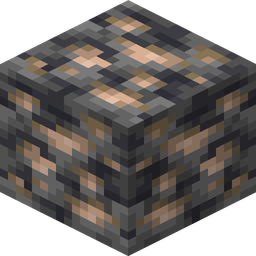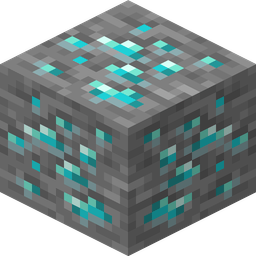
Diamonds generate between Y=16 and Y=-64, and the distribution rises steadily as you descend, peaking at the very bottom of the world. The practical answer is Y=-59: it is close to the density peak but sits above the bedrock layers and above most of the deep lava. You need an iron pickaxe or better — a stone pickaxe destroys the ore and drops nothing.
Below Y=0 the ore appears as deepslate diamond ore rather than diamond ore. It looks darker, takes about twice as long to break, and drops exactly the same diamond.
Why Y=-59 and not Y=-64
The distribution genuinely peaks at Y=-64, so in raw terms the very bottom is densest. Three things push the practical answer upward:
- Bedrock. The Overworld floor is bedrock from Y=-64 to Y=-60. Y=-64 is solid bedrock; Y=-63 to Y=-60 is a random mix. Y=-59 is the lowest fully mineable layer.
- Lava. Below Y=-54, open lava is common under aquifers. Mining at Y=-59 means lava is frequently at or just above your head height.
- Coverage. A 2-block-tall tunnel at Y=-59 and Y=-58 exposes ore in the bands Y=-60 through Y=-57, which is the densest four-layer slice you can safely occupy.
If you dislike lava risk, Y=-52 to Y=-50 is a reasonable compromise: noticeably fewer diamonds, considerably fewer accidents.
Branch mining, done properly
Branch mining is a strip-search of a fixed volume. It is slower per hour than caving but it is predictable, and you keep everything you mine.
- Dig a staircase down to Y=-59. Place torches on one wall all the way, always the same wall, so you can find your way out.
- From the bottom, dig a main corridor 2 blocks tall and 1 block wide, as long as you have patience for — 100 blocks is a normal session.
- Every few blocks along the corridor, dig a branch perpendicular to it, again 2 tall and 1 wide, 30 to 50 blocks long.
- Torch each branch as you go and seal any cave you break into unless you want to explore it.
Branch spacing is the one decision that matters:
| Gap between branches | Blocks of stone between | Coverage of the band | Speed |
|---|---|---|---|
| 2 | 1 | Complete, heavily redundant | Slowest |
| 3 | 2 | Complete for the 2-block band | Balanced — recommended |
| 5 | 4 | Misses roughly half the volume | Fastest per diamond found |
A gap of 3 (two solid blocks between tunnels) leaves no unseen block in the layers you are walking through, because every column between two branches touches at least one tunnel wall. A gap of 5 covers ground faster and still finds most veins, because diamond veins are not single blocks.
Diamond generates in small blobs — typically 1 to 4 blocks, occasionally up to 8 — so a vein you clip the edge of is usually worth following.
Caving, which is faster if you accept the risk
Above roughly Y=0 nothing changes, but the deep cave systems below Y=-40 expose enormous surface area. A single large cave can show you more stone faces than an hour of branch mining, and you get iron, redstone, lapis and gold at the same time.
The trade-offs are real: creepers in an unlit cave will destroy the ore you were walking towards, skeletons shoot from the dark across open chambers, and lava lakes at these depths are large. Bring a water bucket, 64 torches, blocks to pillar with, and a shield.
Avoid the Deep Dark. Ancient cities are at these depths, they are marked by sculk blocks, and the warden that guards them has 500 health and hits for 30 damage through full netherite. If you see sculk, leave.
Fortune, and why it doubles your yield
Fortune on a pickaxe multiplies ore drops. For diamond, the average multipliers are:
| Enchantment | Average diamonds per ore | Best case |
|---|---|---|
| None | 1.00 | 1 |
| Fortune I | 1.33 | 2 |
| Fortune II | 1.75 | 3 |
| Fortune III | 2.20 | 4 |
Fortune III more than doubles your return, which means the first two diamond pickaxes you find should go towards enchanting, not towards mining. Get an enchanting table running before you commit to a long mining session.
Silk Touch drops the ore block itself instead. That is only useful if you want to move the ore or save it to break later with Fortune — for pure yield, Fortune wins outright.
Pair Fortune with Efficiency and Unbreaking; Mending makes the pickaxe effectively permanent because mining ore gives experience directly.
How much experience diamonds give
Mining diamond ore without Silk Touch drops 3–7 experience per block, one of the highest values in the game and comparable to emerald ore. A productive branch-mining session at Y=-59 will passively carry you from level 0 to level 30 on ore experience alone, which is exactly the level you want for enchanting.
The other ways to get diamonds
Mining is not the only source, and for a first diamond it is often not the fastest:
- Buried treasure chests always contain diamonds — 1 to 2 per chest, found by following a buried treasure map from a shipwreck or ocean ruin.
- Desert pyramid chests contain 1–3 diamonds each and there are four chests per pyramid.
- Mineshaft minecart chests, stronghold altar chests and jungle pyramid chests all roll diamonds.
- Ancient city chests contain diamonds among much better loot, if you can get in and out without waking the warden.
- Trial chambers reward chests contain diamonds, and they are far safer than an ancient city.
If you find a desert pyramid before you find deepslate, take the pyramid. Four chests is often a full diamond pickaxe and a spare.
What to make first
The order that gets you furthest per diamond:
- Diamond pickaxe — 3 diamonds. Unlocks obsidian and ancient debris.
- Enchanting table — 2 diamonds. Multiplies everything you do afterwards.
- Diamond sword — 2 diamonds, 7 damage against iron's 6.
- Diamond chestplate — 8 diamonds, 8 armour points and 2 toughness.
- Everything else.
Do not make a diamond shovel or hoe until you have the four items above. A diamond shovel is a luxury; a diamond pickaxe is the gate to the rest of the game.
Frequently asked questions
Does the "diamonds are near lava" rule still work?
Loosely. Both diamonds and open lava are common at the same depths, so they correlate, but lava does not cause or indicate diamonds. Following a lava lake's edge at Y=-55 is a reasonable prospecting route because it gives you lots of exposed stone face, not because the lava is a signal.
Can I find diamonds with a stone pickaxe?
You can find them, but mining them with anything below iron destroys the block and drops nothing. If you spot diamond ore and only have stone, mark the spot, wall it off, and come back. Never break it "to see what happens".
Do diamonds regenerate or respawn?
No. Ore generates once when the chunk is created and never comes back. The only renewable diamond source in vanilla survival is villager trading — some toolsmith, weaponsmith and armourer villagers sell diamond gear for emeralds, which are renewable.
Is Y=-58 better than Y=-59?
The difference is within noise. Standing at Y=-59 with a 2-block-tall tunnel means your feet are at -59 and your head at -58, exposing layers -60 to -57. That is the standard because it maximises exposure to the dense layers without touching the bedrock zone. Arguing over one block here matters far less than branch spacing and Fortune level.