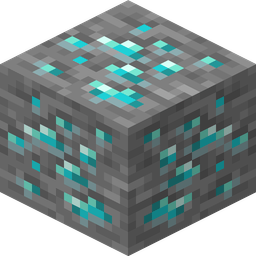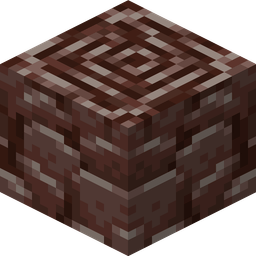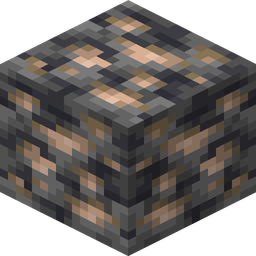
If you only remember one number per ore: diamond Y=-59, redstone Y=-59, gold Y=-16, iron Y=16, lapis Y=0, copper Y=48, coal Y=96, emerald Y=236, ancient debris Y=15. Everything below explains why, and what the ranges actually look like.
These are the Caves & Cliffs distributions, unchanged in 1.21.4. Overworld terrain runs from Y=-64 to Y=320, and most ores use a triangular distribution: density peaks at a single Y and tapers to zero at both ends of the range.
The full table
| Ore | Range | Peak | Best Y to stand at | Pickaxe needed |
|---|---|---|---|---|
| Coal | Y=0 to 192 (second band 136–320) | 96 | 96, or any cliff face | Wooden |
| Copper | Y=-16 to 112 | 48 | 48 | Stone |
| Iron | Y=-24 to 56 (also 80–384) | 16 | 16, or mountain peaks | Stone |
| Lapis lazuli | Y=-32 to 32 | 0 | 0 | Stone |
| Gold | Y=-64 to 32 | -16 | -16 | Iron |
| Redstone | Y=-64 to -32 | -59 | -59 | Iron |
| Diamond | Y=-64 to 16 | -64 | -59 | Iron |
| Emerald | Y=-16 to 320 | 236 | 236 (mountains only) | Iron |
| Nether quartz | Nether Y=10 to 117 | uniform | 15 | Wooden |
| Nether gold | Nether Y=10 to 117 | uniform | 15 | Wooden |
| Ancient debris | Nether Y=8 to 24 | 15 | 15 | Diamond |
| Amethyst | Geodes, Y=-58 to 30 | — | -20 | Wooden |
Two ores in that table are outliers worth reading twice: emerald, which is a mountain ore and essentially absent from deep caves, and iron, which has a huge second band in mountain terrain that makes snowy peaks a faster iron source than any mine.
Deepslate: what changes below Y=0
Below Y=0 the stone becomes deepslate and every ore in it becomes its deepslate variant — deepslate diamond ore, deepslate iron ore, deepslate gold ore and so on.
The drops are identical. What changes is hardness: deepslate takes roughly twice as long to break as stone, and the deepslate ore variants take about twice as long as their stone counterparts. This is exactly why Efficiency matters more below Y=0 than above it. An Efficiency V diamond pickaxe makes deepslate feel like stone.
The transition is not a clean line — the two stones interleave between about Y=0 and Y=-8.
Ore by ore, with the details that matter
Coal
The most abundant ore and the only one you can mine on day one with a wooden pickaxe. It generates in very large veins — up to 17 blocks — and its upper band from Y=136 to Y=320 is why cliff faces and mountainsides are covered in it. Deliberate coal mining is almost never worth a trip: prospect on the surface instead, or burn logs into charcoal.
XP: 0–2 per block.
Copper
Copper generates in the largest veins of any ore, frequently 20 or more blocks, and is dramatically more common in dripstone caves. It has essentially no early-game use beyond lightning rods, spyglasses and building blocks, which is why most players end up with several stacks they never spend.
XP: 0 (drops raw copper).
Iron
Three overlapping bands: the main one peaking at Y=16, a mountain band from roughly Y=80 to 384 peaking near Y=232, and a thin scatter from bedrock upward. The mountain band is the important one — a jagged peaks or snowy slopes biome will have visible iron on the surface, and you can gather several stacks without going underground.
Iron drops raw iron, which needs smelting, and drops no XP.
Lapis lazuli
Peaks at Y=0 with a narrow range, so it is the one ore where a dedicated level genuinely differs from the diamond level. In practice you pick lapis up incidentally while descending, and you need a lot of it: 3 lapis per level-30 enchantment, which adds up quickly once your enchanting table is running.
XP: 2–5 per block, and Fortune multiplies the drop.
Gold
Peaks at Y=-16 in the Overworld, and generates far more abundantly in badlands biomes, where it appears in much larger quantities and much higher up. If your world has a badlands, that is your gold mine.
Gold's real value is piglin bartering and golden carrots, not tools. A golden pickaxe has 32 durability.
Redstone
Redstone occupies the same depths as diamond — Y=-64 to -32, peaking around Y=-59 — which means every diamond branch mine is also a redstone mine. A single redstone ore block drops 4–5 dust, and Fortune III averages around 7. You will end up with more redstone than you can use.
XP: 1–5 per block.
Diamond
Range Y=16 down to Y=-64 with density increasing all the way down. Mine at Y=-59 with an iron pickaxe or better. Veins are 1–4 blocks typically, up to 8. XP 3–7.
Emerald
The strangest distribution in the game: emerald generates only in mountain biomes (windswept hills, meadows, jagged peaks, frozen peaks, stony peaks, grove, snowy slopes), from Y=-16 up to Y=320, peaking around Y=236. It generates as single blocks rather than veins, so you will never find a cluster.
Mining emerald is a poor use of time. Villager trading produces emeralds faster than any pickaxe ever will.
Nether ores
Nether quartz ore and nether gold ore are uniformly distributed through the Nether from Y=10 to Y=117, with nether gold also concentrated heavily in basalt deltas. Both break with a wooden pickaxe and both are extremely common — a short tunnel through netherrack yields more quartz than most players need for comparators and daylight detectors.
Ancient debris
Y=8 to 24 with a peak at Y=15, plus a much rarer band extending upward. Requires a diamond pickaxe. It is blast-resistant and fire-proof, which is what makes TNT and bed mining viable at that depth.
A mining plan that covers everything
If you want one trip that gets you everything worth having:
- Y=-59. Branch mine for diamond and redstone. You will pass gold and lapis on the way down.
- Y=-16 on the way back up. A short horizontal detour for gold if you have not found a badlands.
- Y=16 or a mountainside. Iron, in whatever quantity you need.
- Nether Y=15. Ancient debris and quartz in the same tunnels.
- A mountain biome. Emerald only if you have no villagers.
Coal and copper you will collect without trying.
Frequently asked questions
Is there a single Y level that is best for everything?
No, but Y=-59 comes closest for the ores that matter most. It sits at the peak for both diamond and redstone, it is within gold's range, and it is close enough to lapis's lower tail to pick some up. It gives you nothing for iron, copper, coal or emerald, all of which are easier to find elsewhere anyway.
Do ores generate differently in different biomes?
For most ores, no — the distribution is the same everywhere. The exceptions are real and worth knowing: emerald generates only in mountain biomes, gold generates far more heavily in badlands, and copper is more common in dripstone caves. Deep dark biomes contain the same ores but come with a warden.
Does Fortune work on every ore?
Fortune multiplies drops for coal, diamond, emerald, lapis, redstone, nether quartz and amethyst — the ores that drop an item. It does nothing for iron, copper, gold or ancient debris, which drop a raw block that must be smelted; for those, Fortune has no effect and Silk Touch is equally pointless. Keep a Fortune pickaxe and an unenchanted or Silk Touch spare.
Why do I never find deepslate emerald ore?
Because emerald peaks at Y=236, more than 230 blocks above the deepslate transition. Deepslate emerald ore exists, but it is generated only by the thin lower tail of the distribution, making it one of the rarest naturally occurring blocks in the game.