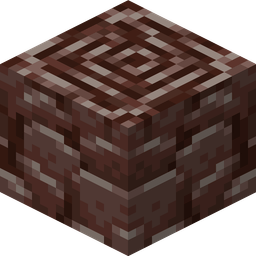
Ancient debris generates in the Nether between Y=8 and Y=24, peaking at Y=15, and requires a diamond pickaxe or better. It never generates exposed to air, so you cannot find it by walking through caves — you have to tunnel through solid netherrack or blow it up.
Four ancient debris smelt into four netherite scrap, which combine with four gold ingots to make one netherite ingot. A full set of tools and armour is nine ingots, so 36 ancient debris is the number to aim for.
Why Y=15 specifically
The distribution peaks at Y=15 and tapers to nothing by Y=8 below and Y=24 above. A second, much thinner band scatters upward through the Nether, but it is rare enough to ignore.
Standing at Y=15 with a two-block-tall tunnel exposes Y=15 and Y=16, which straddles the peak. Some miners prefer Y=13 or Y=14 because it puts more of the dense band at eye level; the difference is small.
There is one more consideration: lava. The Nether's lava sea sits at Y=31, so at Y=15 you are well below it and every pocket you break into is a genuine hazard rather than a curiosity. Bring Fire Resistance potions.
Method 1: bed mining
The fastest method by a wide margin, and the one experienced players use.
Beds explode when used in the Nether. The explosion is roughly the strength of a TNT charge, destroys netherrack in a wide radius, and — critically — does not destroy ancient debris, which is blast-resistant. What you are left with is a crater with any debris in range sitting exposed.
The procedure:
- Tunnel to Y=15 and dig a horizontal corridor.
- Every 5–6 blocks, dig a small alcove in the wall two blocks deep.
- Place a bed at the far end of the alcove.
- Stand back around the corner, out of line of sight, and right-click the bed with something long — or simply place the bed, run three or four blocks away, and shoot it with a bow.
- Collect any exposed debris and repeat.
Bring 20–30 beds. Three wool and three planks each is cheap if you keep sheep.
Safety notes. The blast will kill you outright at close range. Always break line of sight. Wear Blast Protection armour if you have it. The explosion also opens holes into lava, so have a water bucket — remembering water does not place in the Nether, so it only helps you back in the Overworld. Fire Resistance is the real safeguard here.
Method 2: TNT mining
Functionally identical to bed mining but uses TNT instead. TNT is more expensive (gunpowder and sand) but has a fuse, which makes it much safer: place, light with flint and steel, walk away.
The standard pattern is a line of TNT every 4 blocks along a corridor, lit from one end so the chain propagates. Bring at least a stack.
Method 3: straight branch mining
Slow but requires nothing beyond a pickaxe.
Dig a 1×2 corridor at Y=15 and branch off it. Because ancient debris generates in veins of 1–3 blocks, branch spacing of 2–3 gives near-complete coverage. Expect roughly 1 to 3 debris per few hundred blocks mined — it is genuinely rare, at around one vein per chunk on average across its whole range.
An Efficiency V diamond or netherite pickaxe with Unbreaking III makes this bearable. Ancient debris itself takes about 15 seconds to mine by hand with a diamond pickaxe and roughly 4 seconds with Efficiency V.
The Nether roof, and why people use it
The Nether has a bedrock ceiling at Y=128. Above it is a flat, mob-free plane where you can travel at full sprint speed with no ghasts and no lava. Getting up there requires breaking bedrock, which is not intended behaviour and is often disallowed on multiplayer servers. It is not required for debris mining — the ore is 113 blocks below the roof — but it is a common transit route.
Turning debris into gear
The chain is fixed and there are no shortcuts:
| Step | Input | Output |
|---|---|---|
| 1. Smelt | 1 ancient debris | 1 netherite scrap |
| 2. Craft | 4 scrap + 4 gold ingots | 1 netherite ingot |
| 3. Smith | Diamond item + 1 ingot + 1 upgrade template | Netherite item |
The netherite upgrade smithing template is the step people forget. It is found in bastion remnant chests, and a bastion's treasure room has a guaranteed one in the loot pool. You can duplicate a template at a crafting table using 1 template, 7 netherrack and 1 diamond, which produces 2 templates — so you only ever need to find one.
Upgrading at a smithing table preserves the item's enchantments, name and current durability percentage. Enchant your diamond gear first, then upgrade. Doing it the other way round wastes nothing, but doing it in the right order means you are enchanting a cheaper item.
What netherite actually gives you
| Property | Diamond | Netherite |
|---|---|---|
| Pickaxe durability | 1,561 | 2,031 |
| Sword damage | 7 | 8 |
| Armour points (full set) | 20 | 20 |
| Armour toughness (full set) | 8 | 12 |
| Knockback resistance (full set) | 0 | Yes, 10% per piece |
| Mining tier | Obsidian, debris | Same |
| Burns in lava | Yes | No |
The armour points are identical. What you gain is toughness, which reduces how much high-damage hits penetrate your armour, a small amount of knockback resistance, 30% more durability, and one extra point of melee damage.
The genuinely decisive property is the last row. Netherite tools, armour and ingots are fireproof — they float on lava instead of burning. If you die in lava wearing netherite, your gear is waiting for you. That single fact is worth more than every stat above it.
Netherite gear is also repaired with netherite ingots on an anvil, which is expensive; Mending is effectively mandatory on a netherite set.
A realistic time budget
For a full set — netherite sword, pickaxe, axe, shovel, hoe, helmet, chestplate, leggings, boots — you need 9 ingots, which is 36 ancient debris and 36 gold ingots.
- With beds and a good corridor at Y=15, that is roughly two to four hours of focused mining.
- With plain branch mining, considerably longer.
- Gold is not a constraint: piglin bartering, nether gold ore and bastion chests supply it faster than you will find debris.
Most players stop at four ingots: sword, pickaxe, chestplate and leggings. Those four cover the cases where netherite's toughness and fire resistance actually change outcomes.
Frequently asked questions
Can I find ancient debris without a diamond pickaxe?
You can uncover it with explosions, but you cannot pick it up — mining ancient debris with an iron pickaxe or worse destroys the block and drops nothing. Get diamond first. This is not a soft recommendation; it is the tool tier requirement.
Is Fortune useful on ancient debris?
No. Ancient debris drops itself as a block rather than an item, so Fortune has no effect, and Silk Touch is equally redundant. Use Efficiency and Unbreaking instead.
Does netherite armour make me immune to lava?
No. It stops your gear burning and it does not burn away when dropped, but you still take full lava damage. Only a Potion of Fire Resistance makes lava harmless to the player.
Where do I find the netherite upgrade smithing template?
Bastion remnants, in the Nether. Every bastion treasure room contains one as guaranteed loot, and other bastion chests can roll it too. Bastions are guarded by piglin brutes with 50 health that attack regardless of whether you are wearing gold, so go in with a plan and a way out.
Should I upgrade my armour or my tools first?
Tools, specifically the pickaxe. It is the item you use most, its durability gain is largest in absolute terms, and losing a fully enchanted pickaxe to lava is the most annoying loss in the game. Armour second, starting with the chestplate.