Every food has two values: hunger, the visible drumsticks it restores, and saturation, a hidden reserve that is consumed before the hunger bar starts dropping. Saturation is why a golden carrot keeps you fed roughly twice as long as an apple despite restoring less of the visible bar.
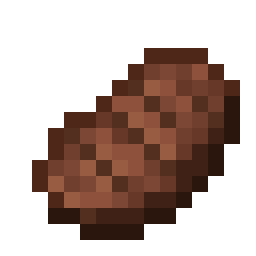
The short answer: eat cooked beef, cooked porkchop or golden carrots. Everything else is a compromise.
How the three bars interact
- Hunger runs from 0 to 20 (10 drumsticks). Visible.
- Saturation runs from 0 to your current hunger value. Invisible. It can never exceed your hunger.
- Exhaustion is an invisible counter that fills as you act. Every 4.0 exhaustion drains 1 saturation, or 1 hunger if saturation is already 0.
So the order is: you act, exhaustion accumulates, saturation drains, and only when saturation is empty does the visible bar begin to fall. A food with high saturation is a food that delays the drumsticks moving.
What generates exhaustion
| Action | Exhaustion |
|---|---|
| Sprinting, per metre | 0.1 |
| Jumping | 0.05 |
| Jumping while sprinting | 0.2 |
| Swimming, per metre | 0.01 |
| Breaking a block | 0.005 |
| Attacking or being damaged | 0.1 |
| Regenerating 1 health | 6.0 |
The two entries that dominate real play are sprint-jumping and regeneration. Sprint-jumping across a landscape is by far the fastest way to empty a food bar, and healing back from half health costs 120 exhaustion — the equivalent of 30 saturation points, or roughly four steaks' worth of reserve.
The two regeneration modes
- Hunger 18 or above: you regenerate 1 health roughly every 4 seconds.
- Hunger 20 and saturation above 0: you regenerate 1 health roughly every half-second. This is "fast regen", and it is why a full-saturation player recovers from a fight almost instantly.
- Hunger below 18: no natural regeneration at all.
- Hunger below 6: you cannot sprint.
- Hunger at 0: you starve, losing health down to 10 on Easy, 1 on Normal, and to death on Hard.
The practical rule that follows: eat back to 20 before a fight, not after. Fighting at 19 hunger means slow regeneration; fighting at 20 with saturation banked means you heal between hits.
The food table
Saturation below is the actual saturation restored, which equals hunger × ratio × 2, capped at the food's own hunger value where relevant.
| Food | Hunger | Saturation | Notes |
|---|---|---|---|
| Golden carrot | 6 | 14.4 | Highest saturation in the game |
| Cooked beef | 8 | 12.8 | Best non-gold food |
| Cooked porkchop | 8 | 12.8 | Identical to steak |
| Rabbit stew | 10 | 12.0 | Fills the bar from empty in one item |
| Cooked mutton | 6 | 9.6 | |
| Cooked salmon | 6 | 9.6 | |
| Golden apple | 4 | 9.6 | Also Absorption and Regeneration |
| Cooked chicken | 6 | 7.2 | |
| Mushroom stew | 6 | 7.2 | Renewable with no animals |
| Beetroot soup | 6 | 7.2 | |
| Bread | 5 | 6.0 | The cheapest reliable food |
| Baked potato | 5 | 6.0 | Easiest crop to mass-produce |
| Cooked cod | 5 | 6.0 | |
| Cooked rabbit | 5 | 6.0 | |
| Pumpkin pie | 8 | 4.8 | High hunger, poor saturation |
| Carrot | 3 | 3.6 | |
| Apple | 4 | 2.4 | |
| Melon slice | 2 | 1.2 | Poor; farm melons for gold melons |
| Honey bottle | 6 | 1.2 | Clears Poison; drinks, not eats |
| Sweet berries | 2 | 0.4 | Snack only |
| Rotten flesh | 4 | 0.8 | 80% chance of Hunger for 30s |
| Poisonous potato | 2 | 1.2 | 60% chance of Poison |
| Pufferfish | 1 | 0.2 | Poison, Nausea, Hunger. Do not eat |
Reading the table
Golden carrots have the highest saturation of any food, at 14.4. They cost 8 gold nuggets and a carrot each, which sounds expensive until you have a gold farm or a piglin bartering setup, at which point they become the default food of the late game.
Steak and cooked porkchop are the best food you can get without gold: 8 hunger and 12.8 saturation. One stack fills the bar four times over with reserve to spare.
Rabbit stew restores 10 hunger — half the entire bar — but does not stack, which makes it a poor travelling food.
Pumpkin pie is a trap. It looks strong at 8 hunger, but its 4.8 saturation means it runs out fast. It stacks to 64 and is cheap, so it is fine for a farming session at home and wrong for an expedition.
Bread and baked potatoes are the workhorses. Neither is impressive, but both come from crops you can automate, and 6.0 saturation is enough.
Food you should not carry
- Rotten flesh applies the Hunger effect 80% of the time, which drains the bar you just filled. It is emergency food only — or dog food, since wolves eat it with no ill effect.
- Melon slices, sweet berries, raw fish and cookies all have saturation ratios of 0.6 or below, meaning they fill drumsticks that immediately start emptying again.
- Pufferfish is only useful as a brewing ingredient for Water Breathing.
- Raw chicken has a 30% chance of Hunger. Cook it.
The special foods
Golden apple: 4 hunger, 9.6 saturation, plus Absorption II for 2 minutes (4 extra hearts of temporary health) and Regeneration II for 5 seconds. It is a combat item, not a meal — eat it when you are about to take damage, not when you are hungry.
Enchanted golden apple: the same food values with Absorption IV for 2 minutes, Regeneration II for 20 seconds, Resistance and Fire Resistance for 5 minutes. No longer craftable; found only in loot chests, which makes each one a genuine resource.
Honey bottle: clears the Poison effect instantly. Worth carrying two when fighting cave spiders or in a swamp with witches. It is drunk rather than eaten, and drinking is slightly slower.
Suspicious stew: 6 hunger, 7.2 saturation, plus a status effect determined by the flower used. Made with a blue orchid or dandelion it gives Saturation, an effect that instantly fills both bars.
Chorus fruit: 4 hunger, teleports you up to 8 blocks. Situationally useful for escaping, dangerous everywhere else.
What to actually carry
- Early game: a stack of bread or baked potatoes, plus whatever meat you cook.
- Mid game: a stack of steak. It is the best value per inventory slot until you have gold.
- Late game: a stack of golden carrots and 3–5 golden apples in a separate slot for fights.
One stack of any of the top-tier foods is far more than a session needs. The mistake is carrying four different half-stacks of mediocre food instead of one stack of good food.
Frequently asked questions
Why does my hunger bar drop so fast?
Sprint-jumping. It costs 0.2 exhaustion per jump on top of 0.1 per metre sprinted, making it roughly three times as expensive as walking. If you are crossing distance and not in danger, walk or use a boat, a minecart, or the Nether.
Can I eat when the hunger bar is full?
Not ordinarily — the eat action is blocked at 20 hunger. The exceptions are golden apples, enchanted golden apples, honey bottles, milk buckets and chorus fruit, all of which can be consumed at any time because their value is the effect rather than the food.
Does eating stop the Hunger effect?
No. The Hunger status effect (from rotten flesh, a pufferfish or a husk hit) increases exhaustion for its duration; eating during it just delays the loss. Milk removes it, as it removes every status effect.
Is the Saturation effect the same as food saturation?
They are related but not the same. The hidden saturation value is the reserve described above. The Saturation status effect, from suspicious stew, instantly restores both hunger and saturation while it is active. It is by far the strongest food effect in the game and the reason blue orchid stew is worth farming if you have the flowers.