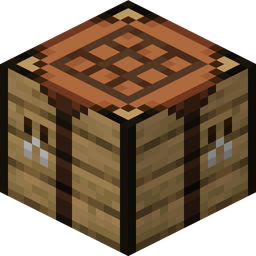
Minecraft crafting is a grid-matching system. You place ingredients into a 2×2 grid (your inventory) or a 3×3 grid (a crafting table), and if the arrangement matches a registered recipe, the result appears in the output slot. Most recipes care about the shape; a minority do not. That distinction is the whole system.
Everything else — furnaces, smithing tables, stonecutters, brewing stands — is a separate crafting-like station with its own rules, and knowing which station is cheapest for a given item saves a surprising amount of material.
Shaped versus shapeless recipes
Shaped recipes require a specific arrangement. A pickaxe is three of a material across the top row and two sticks down the middle column. It does not matter where in the 3×3 grid you put that pattern — you can shift it left, right, up or down, as long as the relative positions are intact. A pickaxe made in the top-left corner is the same pickaxe made in the bottom-right.
Shapeless recipes only care about which items are present. Four planks anywhere in the grid make a crafting table only because that recipe is shaped as a 2×2 block, but mushroom stew is genuinely shapeless: a bowl, a red mushroom and a brown mushroom in any three slots produce mushroom stew. Dyes, bone meal, firework stars and most "combine these ingredients" recipes are shapeless.
A practical consequence: if a shaped recipe is not producing an output, your spacing is wrong, not your ingredients. If a shapeless recipe fails, you have the wrong ingredient.
The 2×2 versus 3×3 grid
Your inventory has a permanent 2×2 grid. It can make anything that fits in two rows and two columns:
- Planks from logs
- Sticks from planks
- Torches from coal and a stick
- A crafting table from four planks
Everything wider or taller — every tool, every piece of armour, every furnace, every door — needs the 3×3 grid of a crafting table. This is why a crafting table is the first thing you build, and why you carry it with you rather than leaving it at home.
Ingredient tags: why "any planks" works
Most recipes accept a tag rather than a specific item. Any of the wood types work for planks-based recipes; any log works for planks; any of the many stone types work where "stone" is required. You can make a chest with four oak planks and four spruce planks in the same recipe. The recipe book will show one variant, but the game accepts all of them.
The important exceptions are recipes that specify an exact item: obsidian for an enchanting table, nether wart for brewing, and the ingot tiers for tools, where iron and gold are not interchangeable.
Tool and armour tiers at a glance
Tool recipes are identical across tiers — only the material changes. What changes with the tier is speed, durability and damage.
| Tier | Pickaxe durability | Mining speed | Sword damage | Full armour points |
|---|---|---|---|---|
| Wood | 59 | 2× | 4 | — |
| Gold | 32 | 12× | 4 | 11 |
| Stone | 131 | 4× | 5 | — |
| Iron | 250 | 6× | 6 | 15 |
| Diamond | 1,561 | 8× | 7 | 20 |
| Netherite | 2,031 | 9× | 8 | 20 (+12 toughness) |
Gold is the fastest-mining tier and the most fragile: a golden pickaxe breaks after 32 blocks. It is a trap for new players and a niche tool for experienced ones. Diamond is the tier that matters — it is the first that can mine obsidian and ancient debris, and its durability is six times iron's.
Netherite is not crafted in a grid at all. It is made at a smithing table from a diamond item, a netherite ingot and a netherite upgrade smithing template.
Smelting
A furnace takes an input, a fuel, and 10 seconds (200 game ticks) per item. It converts ores into ingots, raw food into cooked food, sand into glass, logs into charcoal and cobblestone back into stone.
Fuel values, measured in items smelted per unit of fuel:
| Fuel | Items smelted |
|---|---|
| Lava bucket | 100 |
| Block of coal | 80 |
| Dried kelp block | 20 |
| Blaze rod | 12 |
| Coal or charcoal | 8 |
| Any planks | 1.5 |
| Any stick | 0.5 |
A lava bucket is the most efficient fuel by a wide margin, but you keep the bucket only if you use it in a furnace — it is consumed and the empty bucket is returned. Dried kelp blocks are the best renewable fuel and are worth building a kelp farm for if you smelt in bulk.
Smelting grants experience when you collect the output, not when the item finishes. A furnace stores that experience, so emptying a furnace after a long batch gives you the whole pile at once.
The faster furnaces
- A blast furnace smelts ores and metal tools/armour at twice the speed — 5 seconds an item — and nothing else.
- A smoker does the same for food.
Both cost a normal furnace plus a few extra materials, and both pay for themselves immediately. Use a smoker for meat and a blast furnace for ore, and keep an ordinary furnace for glass, charcoal and stone.
Stations that beat the crafting table
The stonecutter
A stonecutter converts one stone-family block into one stair, slab, wall, brick or chiselled variant. Crafting stairs on a table costs six blocks for four stairs; a stonecutter gives one stair per block. That is a 33% material saving on stairs and it removes the need to remember the patterns. Slabs are the exception — the table gives 6 slabs from 3 blocks, matching the stonecutter's 1-for-2 rate.
The smithing table
A smithing table does two jobs: upgrading diamond gear to netherite, and applying armour trims. Both need a smithing template in the leftmost slot. Trims are cosmetic; the netherite upgrade is not.
The anvil
An anvil repairs and combines items and applies enchanted books. It costs experience levels rather than materials and has its own rules — see the anvil guide linked below.
The grindstone
A grindstone repairs two damaged items of the same type into one, and strips enchantments off an item while returning some experience. It also resets an item's accumulated anvil penalty, which is its most valuable and least known property.
The recipe book
The recipe book (the book icon beside the crafting grid) unlocks recipes as you obtain their ingredients. Clicking a recipe fills the grid automatically from your inventory, and shift-clicking fills it as many times as your materials allow. It is not a complete reference — it only shows what you have unlocked — but for bulk crafting it is faster than placing items by hand.
Frequently asked questions
Why does my recipe not work when I have all the ingredients?
Almost always spacing. Shaped recipes need the correct relative positions: a pickaxe needs the two sticks directly below the centre of the three-wide top row, with nothing else in the grid. Stray items in unused slots break shaped recipes. Clear the grid and try again with only the ingredients.
Can I craft a bigger grid than 3×3?
No. Vanilla Java Edition has 2×2 and 3×3 only, and no vanilla recipe needs more than nine slots. The crafter block introduced in 1.21 automates a 3×3 recipe with redstone but does not enlarge it.
Is it worth crafting gold tools?
Rarely. A golden pickaxe mines faster than diamond but has 32 durability. Its real uses are enchanting — gold has the highest enchantability of any tier, so a golden item pulls better enchantments from the enchanting table for the same level cost — and then transferring those enchantments to a durable tool with an anvil. As a working tool it is not worth the ingots.
Do I lose materials if I craft the wrong thing?
Not permanently, in most cases. A crafting table can be broken and picked back up, tools can be melted down in a furnace for one nugget (a fraction of the original), and a grindstone recovers enchantments as experience. But converting eight iron into a chestplate you did not want costs you those ingots — smelting armour back only returns nuggets, at roughly one-ninth value.