The pale garden is the headline addition of 1.21.4, and the only genuinely new place to stand in the current version. It is a washed-out variant of the dark forest: grey pale oak trunks, pale moss underfoot, hanging moss in the canopy, and eyeblossoms that open when the sun goes down.
It is also silent. No passive animals generate in a pale garden and the biome carries no ambient sound of its own, so walking out of a dark forest into one is an audible change as much as a visual one. That silence is the point of the biome, and it is the first sign that something in it is watching you.
What grows there
| Block | Where it comes from | What it is for |
|---|---|---|
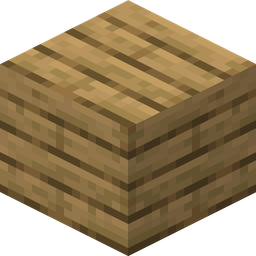
| Pale oak log and planks | Pale oak trees, which are dark-oak-sized | A full grey wood set — planks, stairs, slabs, doors, signs |
| Pale moss block | The forest floor | Spreads with bone meal like ordinary moss |
| Pale hanging moss | Under the canopy | Decoration; it grows downward on its own |
| Open eyeblossom | Ground cover, open after dusk | Orange dye, and suspicious stew that gives Blindness |
| Closed eyeblossom | The same flower by day | Grey dye, and suspicious stew that gives Nausea |
| Resin clump | Formed on trees when a creaking is hurt | Crafts into resin blocks and resin bricks |
Eyeblossoms swap state with the day: open after dusk, closed by day. Both forms can be made into suspicious stew, and neither is worth eating — the open flower gives Blindness and the closed one Nausea. Bees will not thank you for planting them near a hive either.
Resin is the only material that comes out of the biome as a reward rather than as a building block you could have cut anywhere. Resin clumps craft into resin blocks, and resin bricks give you a warm orange that nothing else in the game produces.
The creaking
The creaking is a 2.7-block tall figure of pale wood that emerges at night, and it breaks two rules the rest of the game plays by.
It cannot be hurt. Its health value is 1, but every hit you land does nothing except flash a red line from the creaking to a nearby pale oak trunk. That line is the information: it is pointing at the creaking heart that is keeping it alive.
It only moves when you are not looking. While any player has it in view it is frozen solid — you can walk around it, stand next to it, and it will not so much as turn. Look away, and it closes the distance instantly. In practice you never see it move; you see it in a different place than it was.
Its other properties:
- It hits for 3 on Normal (2.5 on Easy, 4.5 on Hard), which is not much on its own but adds up when you are backing towards a cliff.
- It cannot be knocked back, cannot be burned, and cannot be pushed with a wind charge.
- It will not follow you outside its heart's range, so walking away always works.
- It vanishes at dawn, and a new one comes out of the same heart the following night.
How to kill one
You do not kill the creaking. You kill the tree it came from.
- Hit the creaking once. A red line flashes from it to a pale oak trunk. That is the tree.
- Walk to that trunk and look at it. Somewhere in it is a creaking heart — a log with an eye in it, awake and visibly pulsing while its creaking is out.
- Break the heart. An axe is fastest. The creaking collapses the moment the heart is gone.
- Damaging the creaking on the way also causes resin clumps to form on the blocks around its heart, so hitting it a few times before you break the heart is free resin.
The whole fight is a navigation problem, not a combat one, and the difficulty is entirely that the thing chasing you is behind you every time you turn around to find the tree. Two habits make it easy:
- Bring a friend, or bring your back to a wall. While anyone is looking at it, it cannot move at all.
- Break the canopy first. Pale gardens are dark under the leaves even at midday, and the creaking is easiest to lose track of in the gloom.
A creaking heart only produces a creaking when it is inside a pale oak with logs around it and only at night, so a heart you break during the day is a heart that never bothers you again.
Should you build here?
As a place to live, no — there is nothing to eat and nothing to breed. As a place to visit, yes: it is the only source of pale oak, pale moss and resin, and a single trip with an axe and a couple of shears supplies a whole build.
If you do want a base in one, clear the creaking hearts first. Sealing a base against ordinary mobs is covered in how to build a base that mobs cannot enter, and all of that still applies — but a creaking is not stopped by light level, because it does not spawn in the dark. It comes out of a block, and the only lasting fix is removing the block.
Frequently asked questions
Where do I find a pale garden?
They generate as a rare variant of the dark forest, so search dark oak country. They are small — often only a few hundred blocks across — and unmistakable once you are in one, because the entire palette drains to grey.
Can I move a creaking heart?
Breaking one gives you the block only with Silk Touch; broken normally it yields resin. A heart you place yourself never produces a creaking — the game marks the naturally generated ones and only those spawn the mob — so there is no way to keep one as a pet or a trap.
Does the creaking drop anything?
Nothing. The creaking itself has no drops and gives no experience. The resin is produced by the heart while the creaking takes damage, which is the closest thing to a reward the fight has.
Is the creaking hostile in daylight?
It does not exist in daylight. Hearts produce a creaking after dusk and it disappears at dawn, so a pale garden in the morning is only unnerving, not dangerous.
Do hostile mobs spawn in the pale garden?
The biome has no ambient animal spawns at all, which is what makes it so quiet, but darkness still works the way it does everywhere else in the Overworld — the canopy keeps the forest floor dim, so light it as you would any dark forest. The mob-by-mob counters are in how to fight every hostile mob.