Инструменты
График уровней Y для руд
Где встречается каждая руда, её пик по Y и лучший уровень для добычи.
Это руководство пока доступно только на английском. Справочные страницы — блоки, предметы, мобы, биомы и рецепты — переведены полностью.
Since the Caves & Cliffs update the world runs from Y=-64 to Y=320, and Mojang rebuilt every ore’s generation to spread across that whole height. The old advice — “dig to Y=11 for diamonds” — has been wrong for years. Diamond now gets denser the deeper you go and peaks at the very bottom of the world; iron generates in mountain peaks as readily as in caves; emerald appears only in mountain biomes and peaks around Y=236, far above sea level.
The chart below draws every ore as a bar across the world height, so you can see at a glance which ones overlap and which are worth a dedicated trip. A solid marker shows where the ore is statistically densest. A dashed marker shows the level actually worth mining at, which is not always the same thing: diamond peaks at Y=-64, but bedrock fills the bottom few layers and lava lakes pool at Y=-54, so Y=-59 is the level a real player stands on.
Pick a dimension and an ore and you get its range, peak, best level, tool requirement and experience drop, plus a note on any second generation band — several ores have one, and it is often the band that matters more in practice.
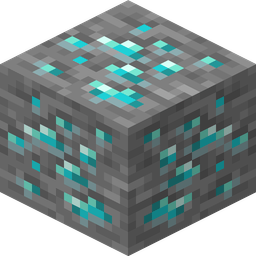
Алмазная руда
Drops Алмаз · needs a iron pickaxe · has a deepslate variant · Fortune works on it
Diamond density increases continuously the deeper you go, peaking at the very bottom of the world. A second, rarer "large" distribution generates buried with no air exposure, which is why open-cave prospecting finds less diamond than tunnelling.
| Ore | Lowest Y | Highest Y | Peak | Best Y | Tool |
|---|---|---|---|---|---|
| Угольная руда | 0 | 192 | 96 | 96 | wooden pickaxe |
| Железная руда | -24 | 56 | 16 | 16 | stone pickaxe |
| Медная руда | -16 | 112 | 48 | 48 | stone pickaxe |
| Золотая руда | -64 | 32 | -16 | -16 | iron pickaxe |
| Редстоуновая руда | -64 | -32 | -59 | -59 | iron pickaxe |
| Лазуритовая руда | -32 | 32 | 0 | 0 | stone pickaxe |
| Алмазная руда | -64 | 16 | -64 | -59 | iron pickaxe |
| Изумрудная руда | -16 | 320 | 236 | 236 | iron pickaxe |
| Аметистовая друза | -58 | 30 | even | -20 | wooden pickaxe |
How this works
How ore generation is described
Each ore has one or more placement rules, and each rule has a vertical distribution. Two shapes cover almost everything:
- Triangle — density rises linearly from zero at the bottom of the range to a maximum at the peak, then falls linearly to zero at the top. Iron, copper, gold, lapis and ancient debris all work this way.
- Uniform — equally likely anywhere in the range. Nether quartz, nether gold and the amethyst geodes are uniform, which is why there is no single best level for them beyond “wherever is safest”.
The bar in the chart shows the range; the solid line shows the peak where one exists. Ores marked “even” in the table have no peak because their distribution is uniform.
A worked example: why Y=-59 for diamond
Diamond’s distribution runs from Y=16 down to Y=-64 and gets steadily denser all the way to the bottom, so the statistical peak is Y=-64 itself. But Y=-64 is solid bedrock, and the bedrock layer is randomly mixed with stone up to about Y=-60, so the lowest level you can dig a clean tunnel in is Y=-59. Lava lakes generate with their surface at Y=-54, which means a tunnel at Y=-59 also sits below most of them — you break into lava from the side rather than falling into it. Y=-59 is therefore the densest level you can actually mine, and the tool reports that rather than the raw peak. Redstone shares the same band, so one tunnel harvests both.
Second bands
Several ores generate twice. Coal has a huge upper band that makes cliff faces the fastest source. Iron has three bands, and the mountain one above Y=80 is often faster than mining. Gold generates normally below Y=32 but pours out of badlands cliffs from Y=32 to Y=256. Lapis has a second “buried” band that never touches air, so it is invisible from caves. The tool shows the primary band on the chart and describes the secondary one in the note under the ore, because drawing both as one bar would misrepresent the density.
Where we are less certain
The ranges and peaks here are for Java Edition 1.21 and match Mojang’s worldgen data files. What is genuinely approximate is the “best Y level”: it is a judgement that balances raw density against bedrock, lava and how much of the range is deepslate, not a value the game defines. Reasonable players disagree by a few blocks — Y=-53 instead of Y=-59 for diamond is a common and defensible choice that trades a little density for a lot less lava. Treat that column as advice, and the range and peak columns as fact.