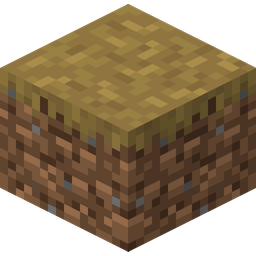
Overview
Farmland is dirt that has been worked with a hoe, and it is the only block wheat, carrots, potatoes, beetroot, melon stems and pumpkin stems will grow on. Two things govern whether it works. The first is hydration: farmland within 4 blocks horizontally of a water source stays dark and moist, and crops on moist farmland grow considerably faster; dry farmland eventually reverts to plain dirt. In practice that means the standard farm layout is a 9-by-9 plot with a single water source in the middle, which hydrates every block in it. The second is light: crops need light level 9 or higher, which either means sky access or torches. The classic mistake is jumping on farmland, which turns it straight back into dirt and destroys whatever was planted — unless you are wearing boots with Feather Falling, which prevents the trample. Farmland can also be trampled by mobs, so fencing a farm matters. A hoe converts dirt, grass, coarse dirt, dirt paths and rooted dirt into farmland with one use, and the higher the hoe tier the more uses it has.
Growing wheat, carrots, potatoes, beetroot and the stems for melons and pumpkins — the entire crop half of the food economy, plus the hay bales and bread that come from it.
In Minecraft 1.21.4, Farmland is a naturally generated block. It is gathered by mining rather than crafted. With a hardness of 0.6 it gives way immediately under almost any tool.
Any tool works, and so do bare hands. What you actually collect is Dirt. A blast resistance of 0.6 means a single creeper will clear it away.
It stacks to 64. Nothing on the crafting grid is made from it.
How to get it
Use a hoe on dirt, grass, coarse dirt or a dirt path. Farmland within 4 blocks of a water source stays hydrated; beyond that it dries out and eventually reverts to dirt.
Tips
- A single water source hydrates farmland 4 blocks in every direction, which is why the standard plot is 9 by 9.
- Jumping on farmland reverts it to dirt and kills the crop — wear Feather Falling boots to prevent it entirely.
- Crops need light level 9, so a covered farm needs torches or lanterns even during the day.
- See automatic crop farms for observer-driven layouts that plant and harvest themselves without you.
How long it takes to break
Farmland sits at hardness 0.6: 0.9 seconds per block with your fists, 0.1 with the correct netherite tool.
The drop does not depend on the tool — bare hands work as well as anything — so the table below is purely about speed.
Each Efficiency level adds level² + 1 to the tool's speed, so a level V tool clears this about 2 times faster than an unenchanted one.
| Tool | No enchantment | Efficiency III | Efficiency V |
|---|---|---|---|
| Hand | 0.9 s | 0.9 s | 0.9 s |
| Wooden | 0.45 s | 0.1 s | instant |
| Stone | 0.25 s | 0.1 s | instant |
| Iron | 0.15 s | 0.1 s | instant |
| Diamond | 0.15 s | instant | instant |
| Netherite | 0.1 s | instant | instant |
| Golden | 0.1 s | instant | instant |
Properties
With 0.6 blast resistance Farmland goes down to any nearby explosion. It is fully opaque and produces no light. A single slot takes 64, the usual full stack. The block is tagged for shovels, and only that class gets the speed bonus; everything else mines at bare-hand rate. Broken normally it drops Dirt rather than itself; Silk Touch is what returns the block, and Fortune raises the ordinary drop instead.
- Transparent
- No
- Required tool
- Any
Drops
Farmland drops Dirt.

Guides and tools that cover this
Frequently asked questions
How do you get Farmland in Minecraft?
Farmland generates naturally in the world; breaking it yields Dirt.
What tool do you need to break Farmland?
No specific tool is required — Farmland can be broken by hand.
Is Farmland blast resistant?
Farmland has a blast resistance of 0.6, so an explosion nearby will destroy it.
How many Farmland fit in one stack?
A stack is 64, and a double chest of them comes to 3,456.
How long does Farmland take to break?
With the correct tool at netherite tier it takes 0.1 seconds; by hand it takes 0.9 seconds.