Overview
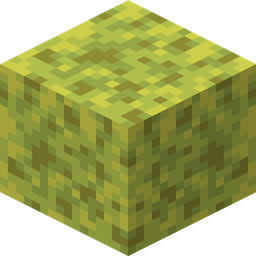
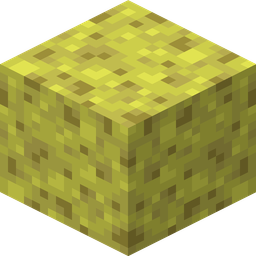
A sponge removes water, and it is the only block in Minecraft that does. Place a dry sponge next to water and it instantly absorbs every water block within a radius of 7 blocks, up to a limit of 65 blocks removed, then turns into a wet sponge and stops. Smelt the wet sponge in a furnace and it dries out again, ready to reuse — with a bucket in the fuel-adjacent slot to catch the water, though most players do not bother. That cycle makes sponges reusable indefinitely, which is why draining an ocean monument with sponges is far more practical than filling it with sand or gravel: you place, you collect, you smelt, you repeat, and you leave the structure intact rather than full of rubble. Sponges come from exactly two places: the hidden sponge rooms inside ocean monuments, which hold dozens of wet sponges in a coral-and-prismarine chamber, and elder guardian drops. In the Nether a wet sponge dries instantly the moment it is placed, which is a small but genuinely useful detail. A sponge placed in flowing water absorbs the source too, which is what makes it work at all.
Draining an ocean monument or any underwater build without filling it with sand, and clearing water out of a flooded mine or base quickly and reversibly.
Sponge is an underwater block in Minecraft Java Edition 1.21.4. With a hardness of 0.6 it gives way immediately under almost any tool. Any tool works, and so do bare hands.
Mining it returns the block itself, so it is safe to relocate. A blast resistance of 0.6 means a single creeper will clear it away. It stacks to 64.
A furnace turns Wet Sponge into it. No recipe takes it as an ingredient.
How to get it
Take wet sponges from the sponge room inside an ocean monument, or kill an elder guardian, which always drops 1. Smelt a wet sponge in a furnace to dry it; each dry sponge clears water in a 7-block radius.
Tips
- Each dry sponge absorbs water in a 7-block radius up to 65 blocks, then must be smelted before reuse.
- Bring at least a stack: a monument drain uses dozens of placements and the smelting is the bottleneck.
- A wet sponge placed in the Nether dries instantly with no furnace needed at all.
- Elder guardians always drop 1 sponge, so a monument raid supplies enough to drain the monument itself.
How long it takes to break
Sponge sits at hardness 0.6: 0.9 seconds per block with your fists, 0.1 with the correct netherite tool.
Nothing here needs a minimum tier: whatever you swing, the block still drops, and the only difference is how long it takes.
Efficiency contributes its level squared plus one to tool speed, which makes Efficiency V roughly 2 times faster than the plain tool.
| Tool | No enchantment | Efficiency III | Efficiency V |
|---|---|---|---|
| Hand | 0.9 s | 0.9 s | 0.9 s |
| Wooden | 0.45 s | 0.1 s | instant |
| Stone | 0.25 s | 0.1 s | instant |
| Iron | 0.15 s | 0.1 s | instant |
| Diamond | 0.15 s | instant | instant |
| Netherite | 0.1 s | instant | instant |
| Golden | 0.1 s | instant | instant |
Properties
Blast resistance on Sponge is 0.6, so any explosion nearby takes it out. It stops light entirely and gives off no light. Stack size is 64 — the standard full stack. A hoe is the fastest choice here. A tool of the wrong class is no better than your fist — the speed bonus is tied to the block's own tool tag.
- Transparent
- No
- Required tool
- Any
Where it generates
- Found in
- Ocean Monument
How to get it
Furnace · 10s · 0.15 XP
Sponge
Drops
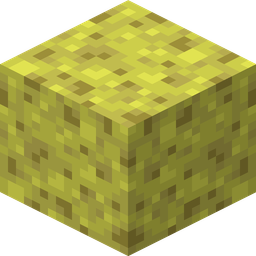
Mined with any, Sponge drops itself.
Guides and tools that cover this
Frequently asked questions
How do you get Sponge in Minecraft?
Sponge comes out of a Furnace: put Wet Sponge in and let it cook.
What tool do you need to break Sponge?
No specific tool is required — Sponge can be broken by hand.
Is Sponge blast resistant?
Sponge has a blast resistance of 0.6, so an explosion nearby will destroy it.
How many Sponge fit in one stack?
Sponge stacks to 64, so a single double chest holds 3,456 of them.
How long does Sponge take to break?
The correct netherite tool clears it in 0.1 seconds. Bare hands take 0.9.